You're standing in the grocery store when your heart starts pounding. Or you're lying in bed and a wave of dread washes over you.
If this sounds familiar, you're far from alone.
About 13 million Americans experience PTSD in any given year, according to the National Center for PTSD. And flashbacks are among the most common and most disruptive symptoms people report.
Yet despite how widespread the experience is, many people who live with flashbacks don't fully understand what's happening to them. That lack of understanding can make your experience even more frightening.
This article breaks down the neuroscience behind flashbacks, explains the difference between visual and emotional flashbacks, and offers research-backed grounding techniques you can use right now.
Flashbacks aren't random. They're the result of specific changes in how the brain processes fear and memory after trauma. Three brain regions are particularly involved.
The amygdala is the part of your brain that detects threats and activates the fight-or-flight response. In people with PTSD, research shows the amygdala becomes hyperactive — it's essentially stuck on high alert.
A 2024 review published in Frontiers in Psychiatry found that people with PTSD show excessive amygdala activity that can be detected on brain scans. Their alarm systems fire more easily, respond more intensely, and stay activated longer than in people without PTSD.
The prefrontal cortex helps you think rationally, regulate emotions, and distinguish between past and present. It's what should tell your amygdala, "That was then — you're safe now."
In PTSD, the connection between the prefrontal cortex and the amygdala is weakened. A 2021 review in Neuropsychopharmacology described PTSD as, in part, a disorder of fear dysregulation — the brain's braking system can't keep up with its alarm system.
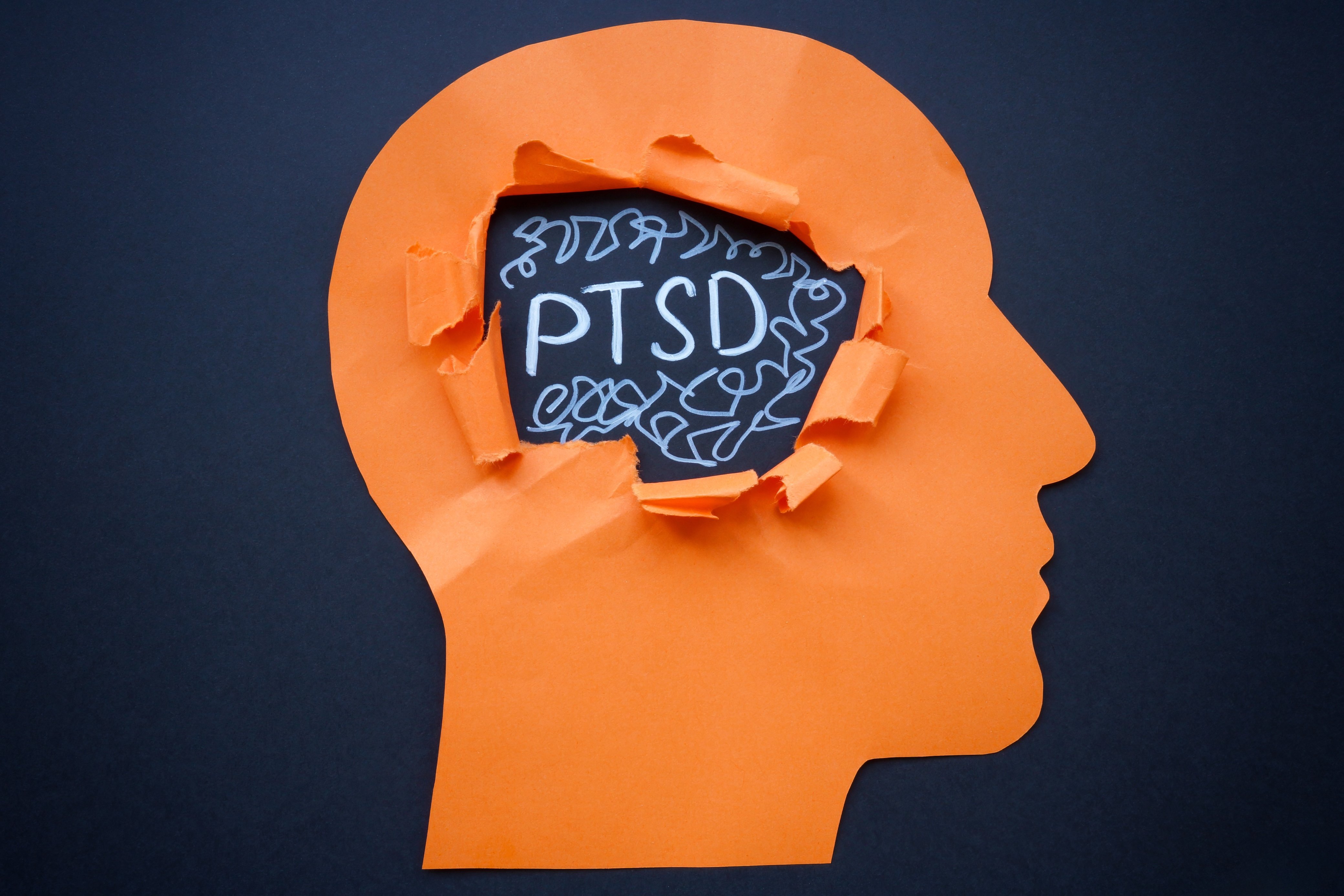
The hippocampus is responsible for organizing memories and placing them in the correct time and context. Trauma disrupts this process.
Instead of being stored as past events, traumatic memories remain fragmented and unprocessed — stuck in the present tense. So when your brain encounters a trigger that resembles something from the original trauma, it doesn't just recall the event. It relives it.
In other words: Flashbacks happen because your brain hasn't filed the traumatic memory away properly. Your nervous system is responding as though the danger is still happening — because, neurologically, it doesn't fully know that it isn't.
If you feel like your triggers are multiplying — or that you're constantly on edge without knowing why — there's a neurological explanation for that, too.
During a traumatic event, your brain doesn't just record what happened. It also records every sensory detail in the environment: the lighting, a specific smell, a tone of voice, a time of day. These details become linked to the threat in your brain's memory system.
Later, when you encounter anything that resembles those details — even loosely — your amygdala can fire the alarm before your conscious mind has a chance to evaluate the situation. This process happens automatically and below awareness, which is why triggers can feel so confusing and unpredictable.
Research on PTSD and fear conditioning has found that people with PTSD tend to over-generalize fearful stimuli. A sound that's only vaguely similar to one from the traumatic event can produce the same fear response as the original threat. Scientists call this sensitization — and it means that without treatment, the range of things that trigger you can actually expand over time.
This isn't a sign that you're getting worse. It's a sign that your nervous system is still operating in survival mode — and hasn't yet received the signal that the danger has passed.
Most people associate flashbacks with vivid sensory replay — seeing, hearing, or feeling the trauma as though it's happening again. These are known as visual or sensory flashbacks, and they're the type most commonly associated with PTSD.
But there's another type that affects millions of people, often without them even realizing it.

The term emotional flashback was coined by Pete Walker, MA, MFT, a psychotherapist specializing in complex trauma and the author of Complex PTSD: From Surviving to Thriving.
Walker defines emotional flashbacks as "sudden and often prolonged regressions to the overwhelming feeling-states of being an abused or abandoned child." These feeling-states can include intense fear, toxic shame, helplessness, rage, grief, or depression.
The key difference: emotional flashbacks typically have no visual component. There's no replay of images or sounds. Instead, you're suddenly overwhelmed by emotions that feel enormous and disproportionate to the current situation.
What an emotional flashback might look like:
Because there's no obvious "movie" playing in your head, emotional flashbacks are incredibly hard to recognize. Most people who experience them don't realize they're having a flashback at all. They just feel like they're overreacting — again.
Walker writes that this is particularly common among people with Complex PTSD (C-PTSD), which develops from prolonged or repeated trauma, especially in childhood. If you grew up in an environment marked by emotional abuse, neglect, or chronic instability, your nervous system may have learned to live in a permanent state of threat. Decades later, everyday situations can reactivate those childhood emotional states.
According to Walker, simply understanding what emotional flashbacks are can bring immediate relief. When people learn that their intense emotional reactions aren't character flaws but are actually delayed responses to childhood trauma, they often begin to treat themselves with compassion rather than self-blame.
Grounding is a set of strategies designed to pull your attention out of the traumatic memory and back into the present moment. The Substance Abuse and Mental Health Services Administration (SAMHSA) describes it as helping someone "step out of the movie theater into the daylight."
The following techniques draw from clinical practice and the lived experience of people who manage flashbacks regularly. Not every technique works for every person — it's worth experimenting to find what resonates with you.
This is one of the most widely used sensory grounding exercises. It works by systematically engaging all five of your senses to anchor you in the present.
This technique works because it forces your brain to process current sensory information, which competes with the trauma memory and helps break the flashback cycle.
During a flashback, your brain loses track of when you are. Saying the following statements out loud — even quietly — can help re-anchor you:
"My name is ___. I am ___ years old. I am in [location]. Today is [day and date]. I am safe right now. What I'm feeling is a memory — it is not happening now."
This directly counters the dissociation that flashbacks cause by giving your prefrontal cortex concrete, present-tense information to work with.
Longer exhales activate the parasympathetic nervous system — the branch responsible for calming the body down after a threat has passed.
Try breathing in for a count of 4, holding for a count of 4, and breathing out for a count of 6. Repeat for at least one to two minutes.
Physical grounding interrupts the fight-or-flight response by drawing your attention to your body in the present:
If racing thoughts are part of your flashback experience, give your brain a task that requires active concentration:
This is especially useful for emotional flashbacks. When you notice the shame, fear, or helplessness rising, try speaking to yourself the way you'd speak to someone you care about:
"This is a flashback. I'm not in danger right now. These feelings are from the past. I'm going to be okay."
Pete Walker emphasizes that self-compassion is fundamental to flashback recovery. Without it, people rarely develop the self-care habits needed for lasting healing.
Tip: Grounding works best when you practice it regularly — not just during a crisis. Try running through the 5-4-3-2-1 technique once a day, even when you feel calm. The more familiar the skill becomes, the easier it will be to access when you actually need it.
Grounding techniques give you something to do in the moment. But managing flashbacks over the long term — learning your triggers, practicing techniques before you need them, and navigating the daily challenges PTSD creates — is a lot harder to do on your own.
This is where peer support can play a meaningful role.
A peer specialist is someone who has lived through their own mental health challenges and has reached a stable place in recovery. They're trained and certified to use that experience to support others — not as a therapist, but as someone who truly understands what you're going through.
Research supports this approach:
How peer support helps with flashbacks specifically:
Trigger identification: A peer specialist can help you recognize patterns in your triggers that you might not see on your own.
Practicing grounding together: Knowing about grounding and being able to use it mid-flashback are very different things. A peer specialist can practice techniques with you and help you figure out which ones work best.
Bridging the gap between sessions: If you're in therapy, a peer specialist helps you apply what you're learning to everyday life.
Reducing isolation: PTSD often drives people to withdraw. Peer support directly addresses this by providing consistent, judgment-free connection with someone who gets it.

At Peerstar, we connect people across Pennsylvania with Certified Peer Specialists and Certified Recovery Specialists — trained professionals who have lived through their own mental health and recovery journeys.
Our peer specialists meet you where you are — at your home, in your community, or by phone or video. Together, you'll work on the real-world challenges that PTSD creates, including managing flashbacks, identifying triggers, rebuilding daily routines, and reconnecting with the life you want to live.
Peer support isn't a replacement for therapy. It's the missing piece that helps you take what you're learning in treatment and make it work in your everyday life.
Our services are covered by Medicaid.
Call us at 215-372-8632 or visit peerstarllc.com.
This article is for informational purposes only and is not a substitute for professional medical advice, diagnosis, or treatment. If you are experiencing symptoms of PTSD, please reach out to a qualified mental health professional. If you are in crisis, contact the 988 Suicide and Crisis Lifeline by calling or texting 988.

.svg)
.svg)




.png)